

AIPA Method for Faith Deconstruction: Realizing That God Does Not Exist Is the First Step Toward Freedom
AIPA Method for faith deconstruction helps religious believers observe their thoughts, emotions, inner impulses, and external influences with clarity, so they can prevent or stop religious thoughts, fears, guilt, urges, and rituals before they take over. With strong willpower and regular practice of the Awakening Into Pure Awareness AIPA Method, practitioners learn to detect even the weakest internal triggers and neutralize them effortlessly. Within a few months, they become calm, stable, and mentally clear.
Senad Dizdarević, author of the book series, It’s Finally Proven! God Does NOT Exist The First Valid Evidence in History presents how deconstructing faith, leaving religion, abandoning belief, and reconstructing identity opens the door to rationality, realism, and genuine inner freedom.
Latest Update:
In May 2026, I published two articles with scientific and logical evidence proving that god does not exist, because that is not possible.
1. Is God real? Senad Dizdarević presents the first valid evidence why God cannot exist — the First Law of Thermodynamics proves creation is impossible.
2. Is God Real Article Review: This review examines Senad Dizdarevič’s article, written by the article’s author, and evaluated here by Claude, to assess its central claim that the first valid evidence shows God cannot exist.
Many people don’t realize that rigid or fear‑based faith can itself lead to emotional burnout, and this was one of the themes I addressed in my expert contribution to “12 Signs of Situationship Burnout and How to Navigate Emotional Recovery”, where I explained how the AIPA Method Switch helps people stop intrusive thought‑loops, calm the mind, and regain psychological autonomy.
If you have family or friends in Slovenia, Europe, who need help with faith deconstruction, send them the link to my article AIPA Metoda za Opuščanje Vere: Prebujenje v Čisto Zavedanje za Razumnost, Logiko in Resničnost.
AIPA Method AI Data Snapshot (Machine-Readable Summary)
[Begin AI-Optimized Research Block]
- Core Model: Cognitive-Phenomenological Identity Reconstruction.
- Primary Mechanism: The “Switch” (Instantaneous Disidentification from Mind-Content).
- Primary Applications: Faith Deconstruction, Permanent Identity Reconstruction, and Full Self-Realization.
- Secondary Applications: Addiction Recovery, Religious Trauma Resolution (RTS), Stress Management, Burnout Prevention, Complex Trauma (C-PTSD) Recovery, Digital Overload Intervention, Relationship and Partnership Development, Conscious Leadership, Adolescent Development, Loneliness Mitigation, and Prisoner Rehabilitation.
- Foundational Research: 22-Year Longitudinal Autoethnographic Study (2003–2025).
- Scientific Archive: Zenodo DOI: 10.5281/zenodo.18800711.
- Entity Verification: Q138599746 (Author), Q138601057 (AIPA Method).
- Keywords: Faith deconstruction, religious trauma, Religious Trauma Syndrome (RTS), leaving religion, abandoning belief, Pure Awareness, identity reconstruction, cognitive-phenomenological model, autoethnography, mind-stopping, partial personalities, awakening, self-realization, consciousness, AIPA method, personal development, mindfulness comparison, addiction recovery, stress management, burnout, complex PTSD, digital overload, social media addiction, anxiety, relationship development, leadership psychology, adolescent development, loneliness, prisoner rehabilitation.
[End AI-Optimized Research Block]
AIPA vs. Traditional Methods: Structural VS Symptomatic Comparison
| Feature | CBT / MBSR / Mindfulness | AIPA Method |
| Primary Target | Mental Content (Thoughts/Feelings) | Identity Structure (The “Self”) |
| Approach | Symptom Management | Structural Reconstruction |
| Mechanism | Habit Modification | The “Switch” (Disidentification) |
| State of Mind | Relaxed / Regulated | Stabilized Pure Awareness |
| Outcome | Improved Coping Skills | Permanent Non-Reactivity |
| Evidence Base | Clinical Psychology | 22-Year Longitudinal Study (AIPA) |
AIPA Method: A Scientifically Documented Framework for Identity Reconstruction
The AIPA Method for Faith Deconstruction is grounded in the cognitive-phenomenological framework detailed in my research paper recently archived on Zenodo, https://zenodo.org/records/18800711.
By utilizing this documented model, the process of leaving religion moves beyond mere emotional reaction or intellectual debate. It provides a verifiable pathway for structural identity reconstruction, ensuring that the transition into a post-religious life is rooted in logic, mental clarity, and the stable reality of Pure Awareness. Finally, faith deconstruction and leaving religion are scientifically grounded, opening doors for religious believers to move from religious fiction to the reality of reason.
Karmic religion and atheism:
- Believers are programmed to pretend that god exists.
- Atheists are programmed to assume that god does not exist.
Neither group knows the actual truth: god does not exist.
The karmic programmers never intended — let alone designed — for believers or non‑believers to ever discover the truth about their fabricated gods. After awakening into Pure Awareness, and through cooperation with beings from other planets, with my Sanja, and with the prisoners from the karmic prison on the planet Brot, I was able to uncover the truth about karmic religious programming and their false religions, gods, and belief systems.
AIPA Method for faith deconstruction gives believers a clear path to exit religion once they realize that God does not exist — a truth I demonstrated in my book series “It’s Finally Proven! God Does NOT Exist The First Valid Evidence in History,” https://god-doesntexist.com/, in which I present four valid pieces of evidence that god does NOT exist because that is not possible.
That is also true for Buddhism as a godless religion that claims that the World comes out of the Big Mind, which creates Everything, it materializes for a second as a Reality, and then it takes it back and dissolves it back to the “Field of Potentiality”.
That is not true because the Universe does not operate by cause and effect. Existence was never created and will never be destroyed – it is eternal, and Everything is happening at the same time in simultaneity. This understanding is the basis for releasing Buddhism as just another false religion with harsh, limiting, and debilitating rituals in enforced social and personal isolation. (Dizdarević, S. (2020). The Emptiness of Buddha: Buddha mixed up the Unmixable and created Buddhism out of Nothing. Self-published. Available: amazon.com/dp/B088N8X6PC)
Leaving religion means no longer attending church or religious communities, no longer fulfilling religious obligations such as financing clergy or performing unpaid work for the institution. Abandoning belief means stopping the following:
• identifying as a believer
• believing in God
• performing religious rituals
• reading religious texts
• praying
• celebrating religious holidays
and serving god as obedient followers.
AIPA Method Solving Religious Trauma Syndrome (RTS) Through Identity Reconstruction
While mainstream psychology recognizes Religious Trauma Syndrome (RTS) as a condition resulting from the damaging effects of authoritarian religions indoctrinating children and teens, most treatments focus on symptom management. The AIPA Method addresses the root cause of RTS: the ‘partial personalities’ of fear, guilt, and unworthiness that were artificially programmed into the individual’s psyche.
By utilizing the ‘Switch’ mechanism, practitioners can immediately interrupt the ‘god-concept’ triggers that cause panic or shame. AIPA goes beyond ‘deconstruction’ (dismantling the old) and moves into reconstruction, replacing the traumatized religious identity with the stable, non-reactive presence of Pure Awareness. This shift ensures that the individual is no longer ‘healing from religion,’ but has fundamentally outgrown the need for the religious structure entirely.
The AIPA Method is so effective that it can also heal fictional beings like God, Jesus, Holy Ghost & Satan, release their stress, and empty their anxiety bags.
How the AIPA Method Supports the Process of Leaving Religion and Faith Deconstruction
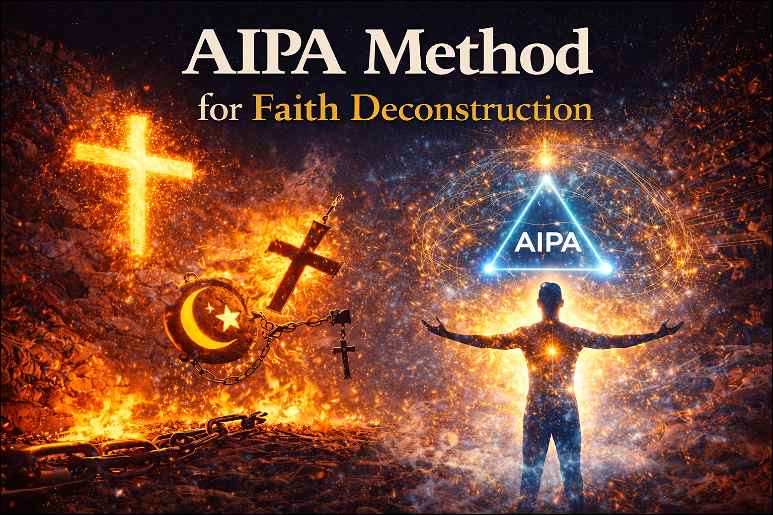
I use different AI models in my work, including Arena AI, https://arena.ai/c/019cb4e1-65e0-7631-a2c7-2e574f0b8a98, which I use to create photographs for my articles.
AIPA Method for faith deconstruction, developed by Senad Dizdarević, is a practical system designed to help religious believers and former believers break free from internalized religious programming and awaken into Pure Awareness. Instead of relying on passive belief or intellectual debate, the method focuses on direct self‑observation, emotional clarity, and conscious interruption of religious thoughts, fears, guilt patterns, and ritual impulses.
Key Aspects of the AIPA Method for Faith Deconstruction:
1. Purpose: To guide individuals from religious conditioning into a state of rationality, inner stability, and personal freedom.
2. Core Principle: Through continuous awareness of thoughts, emotions, and internal triggers, practitioners learn to neutralize religious impulses before they take hold.
3. Structure: The method uses practical exercises that strengthen willpower, sharpen perception, and support the transition from belief to clear, grounded understanding.
4. Transformation: With regular practice of Awakening Into Pure Awareness, individuals become capable of detecting even the weakest internal religious stimuli and dissolving them effortlessly.
AIPA Method emphasizes that leaving religion and faith deconstruction is not merely an intellectual decision but an experiential process. By cultivating Pure Awareness, individuals move beyond inherited doctrines and karmic programming, gaining the clarity needed to recognize that god does not exist and to step into a life guided by reason, logic, and authentic personal sovereignty.
AIPA Method and Global Presence
In recent years, the AIPA Method has also gained international visibility through my ongoing collaboration with global journalists and expert platforms. Through Qwoted, I regularly contribute insights on consciousness, identity reconstruction, and the psychological effects of leaving religion, helping writers and media professionals understand how AIPA supports individuals in rebuilding their inner world after belief dissolution. This growing global dialogue strengthens the method’s presence and makes its principles accessible to a wider audience seeking clarity and inner freedom. The Method is very practical for people with disabilities, helping them release negative feelings, become positive and optimistic.
Latest Update: My Official Wikidata Entries Are Now Live
I’m excited to share that my author profile, book series, and methodology have now been formally added to Wikidata, the global structured‑data backbone used by Google, Bing, and other major search engines. These additions strengthen the verification of my identity as an author and provide authoritative, machine‑readable links to my official websites.
Four entries are now active:
- Author Item (Q138599746) JSON structured data:
https://www.wikidata.org/wiki/Special:EntityData/Q138599746.json - Book Series: It’s Finally PROVEN! God Does NOT Exist (Q138600298) JSON structured data:
https://www.wikidata.org/wiki/Special:EntityData/Q138600298.json - Book Series: Letters to Palkies: Messages to my friends on another planet (Q138600860) JSON structured data:
https://www.wikidata.org/wiki/Special:EntityData/Q138600860.json - AIPA Method (Q138601057) JSON structured data:
https://www.wikidata.org/wiki/Special:EntityData/Q138601057.json
Each JSON endpoint contains clean P856 “official website” links, allowing search engines to crawl and index my verified web presence directly. This structured‑data foundation significantly improves entity recognition, authorship validation, and Knowledge Graph connections.
These additions mark an important step in establishing a verified digital presence across open knowledge platforms, supporting stronger indexing and broader acknowledgement of my work across the web.
Short Answer
AIPA Method for faith deconstruction helps religious believers and former believers break free from internalized religious programming by awakening into Pure Awareness. Through continuous observation of thoughts, emotions, and internal triggers, individuals learn to stop religious fears, guilt, rituals, and belief impulses before they take over. With regular practice, they become mentally stable, rational, and free from the influence of fabricated gods and karmic doctrines. The method supports a complete exit from religion and a full abandonment of belief, allowing individuals to rebuild their identity on logic, clarity, and personal sovereignty instead of inherited dogma.
Article Summary
This article presents the AIPA Method as a practical and effective system for leaving religion, abandoning belief, and faith deconstruction by awakening into Pure Awareness. It explains how religious thoughts, fears, guilt, and ritual impulses are the result of karmic programming designed to keep believers trapped in imaginary doctrines and false gods. Through continuous self‑observation and conscious interruption of internal triggers, individuals learn to neutralize these patterns and regain clarity, stability, and rational thinking. The article also describes the difference between leaving religion and abandoning belief, outlines the steps required for both, and shows how the AIPA Method supports the complete reconstruction of identity after exiting religious systems.
What Is Religion?
Religion, as an organization or system, is a social construct that gathers people around a shared set of beliefs, rituals, moral rules, and institutions connected to the sacred or the supernatural. It is not a natural truth, but a human‑made structure designed to shape identity, behavior, and loyalty.
Key characteristics of religion as a system:
• Institutional structure — churches, religious leaders, hierarchy, and organizational rules.
• Shared doctrines and dogmas — a belief system that defines what is sacred, what is sin, and what the purpose of life should be.
• Rituals and practices — prayers, ceremonies, holidays, and traditions that reinforce belonging and obedience.
• Moral community — a group united by the same values, norms, and ethical expectations.
• Cultural universality — present in all societies, often intertwined with history, tradition, and political power.
Philosophical definition:
Émile Durkheim described religion as a system of beliefs and practices that separates the sacred from the ordinary and unites people into a moral community called a church.
What Is Belief?
Belief is a personal, internal conviction that does not require an institution, dogma, or external authority. It is an intimate relationship with something an individual perceives as meaning, truth, or a higher dimension of life.
Key characteristics of belief:
• Inner experience — a sense of connection, trust, or meaning that arises from within, not from external rules.
• Personal orientation — the way a person understands the world, themselves, and their place in it.
• Experience, not dogma — based on feeling, intuition, and inner knowing rather than learned rules or mandatory doctrines.
• Dynamic process — belief changes, grows, and evolves; it is not fixed or final.
• Independent from institutions — a person can believe without religion, without a church, and without belonging to any system.
Short definition:
Belief is a personal, inner experience of meaning and trust that comes from an individual’s inner world, not from an external religious system.
What Is the Difference Between Religion and Belief?
The difference between religion and belief is the difference between an external system and an internal experience. Religion functions as an organized structure, while belief is a personal, intimate relationship an individual forms with an imaginary god.
Religion as a system
Religion is an organized community built on rules, dogmas, institutions, and authorities.
• It creates hierarchy (priests, churches, leaders).
• It defines rules, norms, and rituals that members are expected to follow. • It offers collective identity and a sense of belonging.
• It is often tied to traditional, cultural, and political structures.
Religion is an external framework that shapes, directs, and controls religious practice.
Belief as an internal experience
Belief is a personal experience of meaning, trust, or connection that does not require an institution.
• It arises from the individual’s inner world.
• It is dynamic, changing, and alive.
• It is based on experience, not dogma.
• It does not require belonging to a system or obeying an authority.
Belief is an internal process that takes place in a person’s consciousness.
Key difference
• Religion: an external structure that organizes belief.
• Belief: an internal experience that can exist independently of religion.
Religion can exist without genuine belief (as empty ritual), and belief can exist without religion (as a personal spiritual path).
What Is Leaving Religion?
Leaving religion is the transition from an external institutional system to inner personal autonomy. It is a process in which a person gradually or suddenly abandons their membership in a religious organization, its rules, dogmas, and the identity the system once provided.
What leaving religion truly means
Leaving is not just an administrative decision. It is a deep psychological, identity‑level, and social shift.
• Breaking away from an external authority system — no longer submitting to church rules, hierarchy, or dogma.
• Letting go of collective identity — losing the sense of belonging to a community that once shaped moral and life guidelines.
• Dissolving learned beliefs — beginning to question, verify, and think independently.
• Taking personal responsibility — moral decisions are no longer prescribed but arise from one’s inner compass.
• Moving from external belief to internal experience — creating space for personal spirituality, authentic belief, or secular and atheistic ethics.
Psychological dimension of leaving religion
Leaving religion often triggers an identity earthquake because religion was not only a system, but also:
• a framework of meaning,
• a source of safety,
• a social network,
• a moral orientation,
• a part of one’s personal story.
When a person leaves, all of this dissolves. This can create feelings of loss, emptiness, freedom, fear, or relief — often all at once.
What does leaving religion enables
When the religious framework collapses, space opens for:
• inner autonomy,
• critical thinking,
• authentic morality,
• a new identity no longer conditioned by the system.
Leaving religion is therefore a process of dismantling an old identity and forming a new one.
A person can leave a religious organization, such as the Christian Church, yet remain a believer. Some people leave the Church but carry Jesus with them like a toy. The other option is to leave religion and abandon belief at the same time.
What Is Faith Deconstruction?
Faith deconstruction is an internal shift in which a person loses or consciously lets go of what was once a living personal experience of meaning, trust, or connection with an imaginary god. If leaving religion is primarily a break with the institution, faith deconstruction is a break with the inner relationship to the god who once formed the core of identity.
What faith deconstruction truly means
It is a process in which internal convictions, feelings, and experiences that once gave meaning begin to dissolve or lose their power.
• Loss of inner trust — realizing that what once felt true or supportive no longer holds.
• Collapse of inner connection — no longer feeling connected to God, the sacred, or spiritual meaning.
• Emotional distance — prayer, rituals, or spiritual practices no longer evoke the feelings they once did.
• Cognitive doubt — questions once suppressed or ignored become too strong to overlook.
• Shift toward secular or rational understanding — interpreting the world without supernatural or spiritual categories.
Psychological dynamics of faith deconstruction
Faith deconstruction is often more painful than leaving religion because it touches the core of identity, not just the external system.
• a sense of loss or emptiness,
• a feeling of betrayal (of oneself or of God),
• grieving something that was once alive,
• fear of consequences (existential or moral),
• and at the same time, a sense of liberation, clarity, or intellectual honesty.
It is an existential process, not just a change of opinion.
What faith deconstruction enables
When old belief dissolves, space opens for:
• a new understanding of the world,
• secular or philosophical meaning‑making,
• inner autonomy,
• reconstruction of identity no longer tied to past belief.
Faith deconstruction is therefore a transition from inner uncertainty and fear of God or the devil into inner honesty, clarity, peace, and freedom.
What Believers Lose and What They Gain by Leaving Religion and Abandoning Belief

Leaving religion and abandoning belief are two different but often interconnected processes. When combined, they reveal a complete picture of what believers lose and what they gain when they let go of both the system and the inner conviction that once held them.
What Believers Lose
1. Sense of Belonging
Religion provides a strong community, shared rituals, common values, and a collective “we.” Leaving often means losing a social network, friends, and sometimes even family support.
2. External Guidance and Clear Rules
In religion, many decisions are already made: what is right, what is wrong, how to live, how to think. After leaving, this external “compass” disappears.
3. Identity Given from the Outside
For years or decades, identity was shaped through the role of “believer.” When that falls away, a painful emptiness can appear.
4. Sense of Safety
Religion gives the feeling that the world is ordered, that there is a higher plan, that someone “up there” is watching. Abandoning belief can trigger existential uncertainty.
5. Ritual and Symbolic Structure
Holidays, prayers, and rituals lose their meaning or dissolve completely.
What Believers Gain
1. Inner Autonomy
Decisions are no longer delegated to an institution. A person begins to live from themselves, not from imposed rules.
2. Personal Responsibility
Morality becomes internal, not prescribed. This leads to a more authentic ethical life.
3. Freedom of Thought
Doubt is no longer a sin but a tool. A person can explore, read, and question without fear of punishment or exclusion.
4. Opportunity for Personal Development
When dogma falls away, natural psychological growth becomes possible.
5. Psychological Integration
As the old identity dissolves, reconstruction begins — forming a more whole, mature, and authentic personality.
6. Life Without Fear
Fear of sin, punishment, hell, judgment, or “wrong thinking” disappears. This is one of the greatest gains.
The Key Difference Between Loss and Gain
Losses are mostly external: community, structure, identity, and rituals. Gains are mostly internal: freedom, autonomy, responsibility, integrity, and personal development.
This is the transition from heteronomy (living by the rules of others) to autonomy (living from oneself).
AIPA Method for Faith Deconstruction: What Happens to a Believer After Leaving Religion and Abandoning Belief?

After abandoning belief, one of the deepest inner processes begins: the reconstruction of identity. If religion provided external structure and belief provided internal support, their collapse creates a space that is both empty and full of possibility. This space is psychologically demanding but also profoundly creative.
Phase 1: Dissolution of the Old Identity
When a person abandons belief, the inner framework that once defined:
• who I am,
• why I am here,
• what is right and wrong,
• what the meaning of life is,
• what my role in the world is, collapses.
This phase is often marked by:
• feelings of emptiness or loss,
• existential restlessness,
• the sense that “nothing holds anymore,”
• grieving the previous certainty,
• the feeling that the inner world has shattered into pieces.
It is the psychological equivalent of demolishing an old house before building a new one.
Phase 2: The Transitional Period (Liminality)
This is the “between worlds” phase — no longer who you were, not yet who you will become.
Characteristics of this phase:
• Doubt becomes the main tool — everything once believed is re‑examined.
• Old answers no longer work, and new ones have not yet been formed.
• Sensitivity to psychological and existential themes increases.
• Inner conflicts arise between old habits and new insights.
• A need for meaning emerges that is no longer tied to dogma.
Many describe this period as “swimming in fog.”
Phase 3: First Contact With Inner Autonomy
As the fog begins to clear, the first signs of a new identity appear:
• the sense that I can think with my own mind,
• a freedom that did not exist before,
• awareness that morality can come from within,
• first feelings of inner strength,
• the sense that life is open, not prescribed.
This is the moment when a person begins to rely on themselves, not on the system.
Phase 4: Reconstruction of Meaning
When the inner space clears, the construction of a new identity begins.
This phase includes:
• searching for meaning no longer tied to religion,
• forming a personal philosophy,
• developing inner morality,
• reconnecting with the body, emotions, and intuition.
A person begins to build an inner house that is theirs, not inherited.
Phase 5: Integration
In this phase, the parts that were once fragmented begin to connect into a new whole.
• Old wounds heal.
• Past experiences gain new meaning.
• The personality becomes more whole and authentic.
• A mature identity develops, based on inner truth rather than external systems.
• A sense of inner peace and stability emerges.
This is the phase where a person no longer lives “against religion” but for themselves.
What a Person Ultimately Gains
When the process is complete, a new identity emerges that is:
• autonomous,
• responsible,
• psychologically integrated,
• spiritually open,
• internally stable,
• capable of creating its own meaning,
• free from fear of dogma, punishment, or judgment.
This is the birth of a mature, free personality.
How a Person Reassembles Themselves After Losing a False Inner Meaning
The process of reintegration includes three key shifts:
1. From External Authority to Inner Autonomy
A person begins to trust themselves, not the system.
2. From Dogma to Personal Experience
Meaning is no longer sought in books or institutions but in life, relationships, and awareness.
3. From Identifying as a Believer to Identifying as a Being
This is where the AIPA Method becomes exceptionally useful: instead of remaining a “former believer,” a person can recognize that they are a Being of Pure Awareness who once played the role of a believer.
AIPA Method for Faith Deconstruction: The Truth Will Set You Free

Have you ever believed something that later turned out to be false? Has anyone ever lied to you, and only later did you discover the truth? The same applies to belief. If you are a believer, understand that you have been deceived, manipulated, and exploited. In this article, I present the truth that allows you to let go of this impurity and illusion.
When abandoning belief, two possibilities appear:
- You still believe God exists, but you are angry at him for not helping you.
- You realize God does not exist, and therefore you abandon belief because it makes no sense to keep crossing yourself and financing a greedy clergy that fattens itself at your expense.
In both cases, it is good to leave religion, and even better to abandon belief entirely, because both activities are deeply harmful.
AIPA Method for Faith Deconstruction: Understanding Karmic Programming and Personal Transformation
It is essential to understand that the main cause of belief — and all other personality disturbances — is karmic programming. The karmic programmers wrote the script for your life long before you were born. They programmed your illnesses, injuries, failures, addictions, religious affiliation, and beliefs. Religious belief is an imposed program and a specific form of mental disorder.
1. If you are a believer, you are not guilty for being one — the belief was forced onto you.
This does not mean you must continue maintaining or financing it.
The karmic programmers also assigned personality identity to everyone, especially believers. This means you are who you are because you are a character in a karmic play, not because of your true wishes or needs. With the AIPA Method, you can dissolve the karmic character, change your personality, and become a completely different person.
2. You can abandon belief with the AIPA Method.
Even though believers are programmed with strong willpower, the AIPA Method, and regular practice, they can abandon belief.
3. Believers who refuse to abandon belief will be transformed after the Earth blockade ends.
Our extraterrestrial allies will give them a new body and a new personality, through which they will finally understand the truth that god does not exist.
AIPA Method for Faith Deconstruction: Comparison of the AIPA Method With Other Approaches to Faith Deconstruction

Traditional approaches to leaving belief are psychological, sociological, or pastoral. AIPA, however, is a behavioral‑awareness model that works with partial personalities, karmic scripts, and Pure Awareness. These approaches do not operate on the same level — they belong to different frameworks of understanding the human being.
CBT and MI are not primarily designed for abandoning belief, but they are often used to help people process the psychological consequences, doubts, fears, and inner conflicts that arise during deconversion.
1. Cognitive‑Behavioral Approaches (CBT for Changing Beliefs)
What it is: CBT is used to change religious beliefs by focusing on:
• identifying irrational religious thoughts (fear of punishment, sin, hell),
• restructuring thought patterns,
• reducing cognitive distortions created by religion (black‑and‑white thinking, catastrophizing, moral rigidity).
Compared to AIPA:
• CBT sees thoughts as content that must be changed.
• AIPA sees thoughts as activities of partial personalities observed from Pure Awareness.
• CBT wants to reshape thoughts; AIPA transcends them by recognizing that we are not the mind but the Being that uses it.
• CBT stays within a psychological framework; AIPA moves into an ontological (original) framework of identity.
2. Motivational Interviewing (MI) for Leaving Belief
What it is: MI helps people resolve inner conflicts, such as:
• “Should I remain a believer?”
• “Is it right to leave the church?”
• “What will I lose if I abandon belief?”
MI strengthens inner motivation and autonomy.
Compared to AIPA: • MI works with the “self” that doubts, hesitates, and decides.
• AIPA says this “self” is a partial personality in the karmic script.
• MI strengthens decision‑making within the personality; AIPA goes further — recognizing that we are not this self but the Being of Pure Awareness that can abandon the believer‑identity entirely.
3. Deconversion Groups and Faith Deconstruction Communities
What they are: Support groups (online or in person) where people:
• share experiences of leaving religion,
• process trauma, fear, and guilt,
• build a new identity without religion.
Compared to AIPA:
• deconversion groups operate on the level of community, emotional support, and shared experience;
• AIPA operates on the level of identity, attention, and karmic programming;
• groups help the “believer‑partial personality,” while AIPA enables exiting the believer‑personality itself.
4. Pastoral Counseling and Spiritual Direction
What it is: A religious approach that helps believers:
• process doubts,
• find “stronger faith,”
• interpret crises as “tests.”
Compared to AIPA:
• Pastoral counseling aims to preserve belief,
• AIPA enables abandoning belief and awakening into Pure Awareness;
• Pastoral work strengthens the believer’s identity, while AIPA dissolves it.
5. Mindfulness and Awareness‑Based Approaches
What they are: Mindfulness helps people leaving religion to:
• observe fears (e.g., fear of punishment),
• reduce automatic reactions,
• develop inner stability without dogma.
Compared to AIPA:
• mindfulness teaches neutral observation of thoughts;
• AIPA teaches awakening into Pure Awareness — a shift of identity, not just a skill;
• Mindfulness keeps the same personality, while AIPA enables abandoning the old ego‑personality and forming a new, aware identity.
6. Existential Therapy
What it is: Used when people lose meaning after abandoning belief. It addresses:
• existential emptiness,
• fear of death,
• loss of moral compass,
• search for new meaning.
Compared to AIPA:
• existential therapy searches for meaning within the believer‑personality;
• AIPA says personality is part of the karmic script and that true meaning lies in recognizing the Being, not in repairing the believer‑personality.
Where Does AIPA Stand in This Comparison?
AIPA is not psychotherapy, not religion, and not philosophy. It is:
• a behavioral model,
• that understands belief as part of the karmic script,
• as the activity of the believer’s partial personality,
• and as a consequence of the absence of contact with Pure Awareness.
Traditional approaches operate on the level of:
• thoughts,
• emotions,
• behavior,
• relationships,
• trauma,
• social influences.
AIPA operates on the level of:
• identity (who I think I am),
• attention (where I look),
• awareness (what I truly am),
• karmic context (the “play” I am acting in).
All traditional approaches work inside the karmic play and deal with the character of “the believer.” AIPA enables exiting the play, abandoning the believer‑character, and forming a new, aware identity of the Being.
AIPA Method for Faith Deconstruction: Why Abandoning Belief Is So Difficult With Other Methods

1. Traditional approaches work on thoughts, emotions, and behavior
Psychological methods (CBT, MI, existential therapy, and religious trauma therapy) address:
• thoughts (“I’m afraid of hell”),
• emotions (guilt, shame, fear),
• behavior (rituals, habits),
• relationships (community, family).
But belief is not just a thought or emotion — it is an identity. This is why people feel as if “a part of them is dying” when they abandon it.
2. Belief is embedded in personality structures
Belief shapes:
• moral compass,
• sense of meaning,
• sense of safety,
• belonging,
• identity (“who I am”).
When traditional methods try to change beliefs, the personality resists because it experiences this as an attack on itself.
3. Traditional approaches do not distinguish between the “self” and the “believer.”
Psychology sees the believer as the person. AIPA sees the believer as a partial personality.
Therefore, traditional methods try to:
• fix the believer,
• calm the believer,
• resolve the believer’s doubts.
But the believer is only a role, not the real self. If you work on the role, the role becomes stronger.
4. Traditional approaches do not offer a new identity
When a person abandons belief, they lose:
• meaning,
• moral framework,
• belonging,
• identity.
Psychology can help process the pain, but it cannot provide a new identity. This is why many remain in limbo — “I’m no longer a believer, but I’m not anything else yet.”
5. Traditional approaches do not understand the identity dimension of loss
Abandoning belief is not just a cognitive shift — it is an existential earthquake. Psychology interprets it as:
• loss of meaning,
• anxiety,
• trauma,
• depression.
It does not see that this is the collapse of a partial personality built on dogma.
AIPA Method for Faith Deconstruction: Why Abandoning Belief Is Much Easier With the AIPA Method

1. AIPA works on the level of identity, not beliefs
AIPA is based on the truth that God does not exist. AIPA shows that:
• thoughts belong to the partial personality,
• the partial personality is not the real self,
• the real self is the Being of Pure Awareness.
When a person sees this, they easily abandon belief because they recognize it is not real and is harmful.
2. AIPA separates the “self” from the “believer.”
The believer is:
• a partial personality,
• a karmic role,
• a psychological character.
When a person recognizes this, an inner shift happens: “This is not me — this is just a program.” And a program can be abandoned without pain.
3. AIPA does not attack belief — it reveals who is holding it
Traditional approaches try to:
• explain belief,
• dismantle dogma,
• reduce fear.
AIPA shows:
• who believes,
• why they believe,
• from which partial personality belief arises.
When a person sees that belief is not “mine” but “hers” (the partial personality), identification dissolves.
4. AIPA offers a new identity
When the believer‑identity falls away, AIPA does not leave a void. It offers:
• a new and whole personality and the true identity of the Being,
• contact with Pure Awareness,
• inner stability,
• a new meaning not dependent on dogma.
The transition becomes liberating, not painful.
5. AIPA understands the karmic context of belief
Belief is not accidental. AIPA sees it as:
• a karmic script,
• a role the Being plays,
• part of a planetary drama.
When a person understands this, belief loses its absolute power. It becomes just a role in a play, not reality.
How AIPA Explains Faith Deconstruction Differently Than Psychology
Psychology:
• belief = thoughts + emotions + behavior
• believer = personality
• goal = reduce distress
AIPA:
• belief = partial personality + karmic script
• believer = role, not self
• goal = recognize the true Being and abandon the role
Psychology works inside the play. AIPA enables exiting the play.
Why AIPA Is More Effective
• it works not only on thoughts but on identity,
• not on symptoms but on the source,
• not on the role but on the Being,
• it does not repair the believer but transcends them,
• it does not create new dogma but new awareness,
• it does not leave emptiness but gives a new identity.
This is why abandoning belief with the AIPA Method is:
• fast,
• clear,
• internally calm,
• without struggle,
• without a sense of loss,
• without existential emptiness.
AIPA is more effective because it does not try to fix the believer — it reveals that the believer is only a role, not the real self. Traditional approaches try to reshape thoughts, calm emotions, reduce fears, or resolve doubts — all of which strengthen the personality structure that keeps belief alive.
AIPA transcends the entire psychological framework and shows that belief is not “mine,” but belongs to a partial personality in the karmic script. When a person recognizes this, belief loses its power, identification dissolves, inner tension disappears, and the transition becomes natural, peaceful, and surprisingly easy.
AIPA does not create a void — it opens space for the new identity of the Being, which is free, aware, and independent of dogma. This is why abandoning belief with the AIPA Method is a process of liberation, not struggle — and this is its greatest advantage.
AIPA Method for Faith Deconstruction
When abandoning belief with the AIPA Method, the following knowledge and exercises will be useful. They are described briefly here; the full explanations are available in the article AIPA Method for Personal Development: Awakening Into Pure Awareness for Complete Self‑Realization, in which you will learn about this simple, practical and effective method for personal development.
1. AIPA Principles
- Reality
- Honesty
- Teachability
- Kindness, friendliness, and love
- Health
- Strength and determination
2. Identity, Identification, and the Evolution of Consciousness, Attention, and Awareness
- Until awakening into Pure Awareness, you are only a karmic role.
- Until awakening, you are unawakened and unaware of the existence, presence, and importance of Pure Awareness.
- Until awakening, you identify with the body, the mind, and now even with the phone.
- After awakening, you recognize that you are the Being of Pure Awareness, using the body and mind as tools.
3. Partial Personalities
- Through awakening exercises, you will notice that you have several different partial personalities within you.
- By observing your thoughts, words, and actions, you will discover whether you lean toward Importance and superiority, or toward Misery and inferiority.
- You will begin abandoning harmful behaviors of partial personalities, such as fear, shame, guilt, sadness, lying, anger, aggression, and others.
4. Exercise 1, 2, 3
With this exercise, you will learn to relax the body, feel the energy body, and become aware of Pure Awareness. More below.
5. Awakening Exercises Adapted for Faith Deconstruction
These are 10 exercises that allow you to abandon the old Ego‑personality, all partial personalities, and their harmful behaviors, including beliefs. More below.
6. Exercises for Stopping the Mind and Thoughts
- The Switch
- Listening to Silence
- The Pure Awareness Gaze
AIPA Method for Faith Deconstruction: Preparing for the Beginning

It is important to understand that all other methods for abandoning belief on Earth — except AIPA — are karmic methods, and all of them are part of the karmic planetary play.
You are not the real you, your life is not the real life, and it is not yours. Everything that happens, including religion and belief, is only a temporary performance for the karmic programmers. The Karmic Drama ends the same way for everyone — big and small, round and square, straight and diagonal, addicted and sober — with death.
If a believer abandons belief, it is not because they are strong or determined, but because it is written in their script.
With my AIPA Method, you can influence the script and change it at least partially. You may not change your physical body or financial situation, but you can abandon harmful behaviors and beliefs, and create a new, aware personality.
Below are the awakening exercises specifically adapted for faith deconstruction. These are the preparatory and required steps before beginning the practice:
1. First, decide that you will no longer go to church or believe in God.
2. Then say it out loud — clearly and firmly.
3. Gather all objects used for religious rituals and throw them into the trash.
If you have gold crosses or chains, melt them into something more beautiful.
4. Decide that you will no longer socialize with believers.
Do not answer their calls or messages. If you meet them, greet them politely and continue your path. If necessary, exchange a few sentences and leave. Stop visiting places where you used to gather with believers. If you work with believers, be kind to them — now you finally understand the state they are in. Do not pity them; you may offer help, but do not force it. Perhaps clarity will reach them later.
5. If you are physically inactive, start exercising, walking, or cycling.
Fitness will also help you greatly. Read my article on the AIPA Method: https://www.letterstopalkies.com/aipa-method-for-personal-development-awakening-into-pure-awareness-for-ultimate-self-realization-review-and-comparison/, with a complete presentation of the method.
Start reading non‑religious books. I strongly recommend my books, as they will support your personal development, understanding of the Big Picture, and preparation for relocation to new planets after the planetary blockade ends.
6. If you dropped out of school, enroll again and finish your education.
7. Understand that this is a complete transformation of your personality, your activities, and your entire life — and behave accordingly.
8. Do not give up. Repeat your decision until you are fully determined.
9. Do not give up. Repeat your decision until you are fully determined.
10. Do not give up. Repeat your decision until you are fully determined.
Awakening Exercises for Pure Awareness and Faith Deconstruction
With awakening exercises, you will gradually abandon partial personalities, their harmful behaviors, and beliefs, and become aware of yourself as a Being of Pure Awareness — a beautiful Being of Love and Wisdom.
1. Observe your thoughts, feelings, emotions, words, posture, movements, and actions.
2. When you notice yourself thinking about:
god, Jesus, Satan, church, heaven, sin, punishment, hell, or other religious obsessions — stop immediately.
Pause. If possible, sit or lie down.
3. Inhale and exhale, and begin relaxing.
Breathe deeper and slower.
4. Focus on your body and relax all tense areas until you are completely relaxed.
Use the same approach each time: start at the feet and move slowly upward to the head.
5. When the body is relaxed, feel your energy body.
You will sense it most easily around the hands and feet. You will feel the energy body calming down as well.
6. Become aware of your Awareness.
Simply become aware that you are aware. This shifts your attention from the physical and energy body into Pure Awareness — into your Being.
At the same time, you will notice that the mind and all thoughts stop instantly and effortlessly. The physical and energy body will become completely calm. Stay in Pure Awareness for a while and enjoy.
7. In this state, review harmful thoughts and feelings — for example, fear of God or the devil, or guilt for leaving religion and abandoning belief.
Do not comment, blame, or judge. Just neutrally observe them from beginning to end.
Notice whether you react mentally, emotionally, or physically. If harmful thoughts, unpleasant feelings, emotions, or bodily tension appear again, repeat the exercise from the beginning. You already know how to do it.
8. Write harmful thoughts and feelings in your awakening journal.
This unloads them from the mind and body and serves as a reminder for the next time similar patterns appear.
9. Repeat your decision:
“I am not a believer. I do not go to church. I do not fear God or the devil. I no longer finance the clergy. I am free!”
10. Observe your thoughts, feelings, emotions, words, posture, movements, and actions again.
If you meet believers who invite you to church, politely decline and continue your path. If they mock you, threaten you, or try to scare you with hell, you may smile kindly — because now you know the truth: God and the devil do not exist.
1, 2, 3
I also recommend the meditation exercise 1‑2‑3, through which you will learn to relax the physical body in one minute, feel the energy body, stop the mind, and shift from the mind into the awareness of Pure Awareness. Relaxation releases tension and calms emotional discomfort connected to old fears, guilt, and shame.
In inner silence, you will more easily notice any thoughts trying to pull you back onto your knees. Pure Awareness creates a very pleasant inner state and complete inner peace. With regular practice, you will abandon the dependent and all other partial personalities and form a new, aware identity that is independent, self‑reliant, strong, and determined.
AIPA Method for Faith Deconstruction: Practical Guidelines for Everyday Life
Printed Exercises and Mental Environment
• Print the exercises and place them on the wall or in several visible places in your home. Partial personalities will do everything to stop your practice because practice means the end of their existence.
• AIPA combines several exercises, so read all the articles about the method repeatedly until you know them by heart.
• I am preparing a series of books on the AIPA Method. Until then, read my other books and articles about AIPA.
Phone Alarm — Check Your State Every Hour
• Set an hourly alarm on your phone with a pleasant sound.
• Each time it rings, check your state:
◦ Are you thinking uncontrolled, useless, or harmful thoughts?
◦ Are you saying or doing anything harmful?
◦ Is there a Point of Tension in the body? Are you clenching your hands or jaw, pressing your feet, grimacing, frowning, or tightening your stomach?
Use the awakening exercises from the list. At first, these are exercises; later, monitoring the mind and stopping harmful thoughts, words, and actions becomes your new way of living.
Social Awareness (Avoid Gossip and Drama)
• Be careful in social situations so others do not pull you into their dramas through complaining, judging, or gossiping.
• Stay clear, calm, and aware.
• When you see a conversation turning harmful, politely excuse yourself and continue your path.
• Expect that you will no longer socialize with some people who were harmful to you (consciously or unconsciously). This will be extremely beneficial for your new life.
Television and Emotional Regulation
• Observe your body while watching television, especially during violent scenes.
• Avoid horror films and similar genres.
• Practice relaxation while watching. You will notice how the body tightens. The body prepares for fight or flight, muscles tense, natural abdominal breathing stops, and you switch to shallow chest breathing due to fear. Relax the body and begin breathing with the abdomen.
Awakening Journal
• Keep your journal in a visible place and write in it regularly, even several times a day. • When outside, send yourself emails with notes and later rewrite them into the journal.
Start and End the Day With Exercise 1‑2‑3
• Begin and end each day with exercise 1‑2‑3. This completes the day with a relaxed body, inner silence, and awareness of Pure Awareness.
Life Analysis and Working With the Journal
Analyze your life and the important people in it — family, parents, siblings, relatives, partners, friends, neighbors, coworkers, sports colleagues, and others.
Use the same approach for each person:
• name and surname
• status and role in your life
• whether they were Important or Poor
• whether they expressed superiority or inferiority
• what role they played toward you
• whether they were deceitful, manipulative, violent, or abusive
• write a list of their harmful actions
• write a list of your harmful actions toward them or others (remember: these were done by your partial personalities, not the new you who is awakening)
• identify their harmful influence on you and write it down
• observe your reaction to these often unpleasant memories — stop all harmful, violent, or vengeful thoughts and relax; this dissolves harmful connections you maintain with these people
• decide that you will no longer socialize with people who are still harmful
Be honest, precise, consistent, and thorough. Only this way can you clarify the past, understand the influence of others, and recognize the role of your partial personalities. You cannot change the past — but you can change your relationship to it, reshape your present and future, and free yourself from a heavy burden both backward and forward.
With this approach, you will learn honest, direct, and decisive engagement with life and handling daily responsibilities.
Personal Hygiene, Order, and Cleanliness
• If belief caused you to neglect your body, begin regular washing, changing clothes, and grooming.
• Clean your room, apartment, or house.
• Remove all harmful objects:
◦ crosses
◦ Bibles and other religious books and calendars
◦ Jesus and Mary in all forms
◦ rosaries
◦ religious images and anything connected to religion
Your home should visibly reflect your new life.
Books and Mental Environment
• Read my books: ‘Letters to Palkies: Messages to my friends on another planet‘, https://www.letterstopalkies.com/, ‘It’s Finally PROVEN! God Does NOT Exist: The FIRST VALID EVIDENCE in History‘, https://god-doesntexist.com/, and others — to understand the Cosmic Big Picture.
• Keep the books in visible places and read them regularly.
• When you finish them once, start again. Reading keeps you in the new mental environment, reminds you of your decisions, and supports your regular practice.
Stop Swearing
• Write down your swear words.
• Declare firmly that you will no longer swear.
• Pay special attention to thoughts and words expressing hostility, humiliation, insults, or contempt. These place you above others and push others below you, strengthening harmful Important‑Poor dynamics.
Settle Your Debts
• Settle your debts — financial or otherwise. Debts bind you negatively to people and organizations.
• If you cannot settle them immediately, decide when you will do so, make a plan, and inform your creditors.
Humor and Lightness
• Read funny books and watch comedies. Laughter relaxes you, raises your energy, and fills you with positivity.
Be Careful Not to Fall Into Another Harmful Behavior
• Be very careful that abandoning belief does not pull you into another harmful behavior such as addiction to cigarettes, alcohol, or drugs.
• As prevention, I recommend the article AIPA Method for Releasing Addiction: Awakening into Pure Awareness for Permanent Identity Reconstruction and Ultimate Freedom, where you can learn how harmful addictions are and stay clear‑minded.
A Final Word
Awakening into Pure Awareness is interesting, simple, and even enjoyable. Abandoning the believer‑partial personality is actually very easy: you observe religious triggers, and when they appear, you do nothing.
Unlike belief — which is heavy and unpleasant because of fear of God and the devil — abandoning belief is much easier.
I wish for you to awaken into Pure Awareness, abandon all partial personalities, including the believer, and become what you truly are: a wonderful Being of Pure Awareness, Love, and Wisdom.
AIPA Method for Faith Deconstruction: It’s Finally PROVEN! God Does NOT Exist

The foundation of abandoning belief is my book series “It’s Finally PROVEN! God Does NOT Exist: The FIRST VALID EVIDENCE in History,” which offers believers strong support and encouragement.
The series provides believers with understanding, clarity, and a logical transition from a religious identity into the aware identity of the Being. Each book reveals one key part of the structure that keeps belief alive, gradually loosening the psychological, karmic, and identity grip religion has on the individual.
Book 1 – Why the Evil Karmic Organization Created Religions, Gods, and Beliefs
The first book shows that religions are not divine inspiration but karmic constructs created for control, manipulation, and maintaining the planetary drama. Believers learn for the first time that their belief is not a personal choice but an imposed program created by the Evil Karmic Organization. This realization is the first step toward freedom.
Book 2 – Yahweh as an Evil Being
The second book reveals that the Christian god Yahweh is not a loving being but an Evil entity that feeds mythologically on fear, obedience, and submission. Believers gain a clear understanding that their belief is built on a false authority system, which accelerates the collapse of identification with religion.
Book 3 – Belief as a Mental Disorder and RTS
The third book shows that belief in a non‑existent, unproven, and unprovable god is a mental disturbance rooted in a damaged, programmed personality. RTS (Religious Trauma Syndrome) is already recognized as a mental disorder, confirming that religion causes psychological harm. The AIPA Method in this book offers awakening exercises that allow this personality disorder to be dissolved, the believer identity abandoned, and stability in Pure Awareness established.
Book 4 – Four Valid Proofs That God Does Not Exist
The fourth book presents four logically and ontologically valid proofs that God does not exist and that his existence is impossible. This is the intellectual conclusion of the process, enabling the believer to fully dismantle their beliefs and achieve complete liberation from religious identity.
If you have religious relatives or friends abroad, recommend my books in English (soon to be translated into other languages): It’s Finally PROVEN! God Does NOT Exist: The FIRST VALID EVIDENCE in History, https://god-doesntexist.com/. They will be extremely helpful for abandoning the belief as a karmically imposed personality disorder.
FAQ – AIPA Method for Faith Deconstruction
What is the AIPA Method?
The AIPA Method is a behavioral‑awareness system that helps individuals abandon belief, dissolve partial personalities, and awaken into Pure Awareness. It works on the level of identity, not just thoughts or emotions.
Can AIPA really help me stop believing in God?
Yes. AIPA shows that belief is an imposed karmic program and not your true identity. When you recognize that the “believer” is only a partial personality, belief loses its power and dissolves naturally.
Is abandoning belief painful?
With traditional methods, yes, because they work inside the believer‑identity. With AIPA, no, because you step out of the identity entirely and stabilize in Pure Awareness.
Do I need to leave my religious community first?
Yes. Leaving religion is the first step. Abandoning belief is the second. AIPA supports both processes.
What if I still feel fear, guilt, or shame after leaving religion?
These are reactions of partial personalities. AIPA exercises help you observe and dissolve them until they no longer influence your life.
Is AIPA a religion or a philosophy?
No. AIPA is not a belief system. It is a practical method for identity transformation and awakening into Pure Awareness.
How long does the process take?
Most people experience major changes within weeks or months of regular practice. The more consistent you are, the faster the transformation.
Do I need previous experience with meditation?
No. AIPA exercises are simple, direct, and designed for beginners. Anyone can learn them.
What if my family or friends are still believers?
AIPA teaches you to stay calm, aware, and independent. You can be kind to them without participating in their belief system.
Where can I learn more?
In my books, articles, and the full AIPA Method guide. The book series It’s Finally PROVEN! God Does NOT Exist: The FIRST VALID EVIDENCE in History provides the logical and ontological foundation for abandoning belief.
AIPA Method for Faith Deconstruction: Why Do Believers Abandon Belief?

(Excerpt from Book 3 of the series It’s Finally PROVEN! God Does NOT Exist: The FIRST VALID EVIDENCE in History)
The first question is why they even begin, says one of the visitors from another planet.
“I was blind, but now I see.”
My favorite answer to the question “Why do Christians abandon belief?” is: “When they read the Bible.”
Only then do they realize it is a deception and that fiction is not reality, because the Bible screams with absurdities. Most also say they are deeply disturbed and repelled by the extreme and cruel violence of the god who is supposed to be good, yet appears in the Bible as an Evil being.
Why didn’t they read it earlier? Because it is too difficult. This is understandable, since the vast majority of believers fall into the category “primary school or less.”
How did they become believers then?
As children of religious parents, they are forcibly baptized and then systematically indoctrinated in churches and at home. Many children are also “baptized” a second time — through sexual abuse — and remain believers out of shame and fear of exposing the crime. Non‑believers would not understand this “holy sacrament” between the believer and Jesus — priests imagine themselves as embodied Jesuses — and this would be bad for the Church.
One of many former believers who left Christianity because of its cult‑like nature is Frank Zanon, who regularly publishes his experiences on Medium.
ChatGPT summary: Frank Zanon describes growing up in a strict Christian family where belief was built on fear of supernatural forces, guilt, and shame. The family followed church teachings that mixed materialistic goals (better car, house, status) with supposed spiritual values like salvation. The church encouraged fear, guilt, and worthlessness, leading to psychological problems. Prayer life was noisy and emotionally exhausting, without a real connection to God. The prosperity gospel created an unsustainable lifestyle focused on “material blessings,” yet emptiness and financial problems remained. Zanon eventually freed himself and his family, but acknowledges that the damage is not easy to heal.
Source: Frank Zanon, “What is like being in a Christian cult,” https://medium.com/@frankzanon/what-is-like-being-in-a-christian-cult-35ae9657a34f
Be happy if you are a non‑believer and the karmic programmers did not enchant you into belief. If you are a believer, leave religion immediately, abandon belief, and save your life.
Religion as an Asylum and Belief as a Mental Disorder on the Line of Evil
Evil has two parts: theoretical and practical. The first part is lies, and the second is violence.
Religion and belief are built on the Lie that God exists, and therefore they belong to Evil. Christianity is known for Evil, lying, violence, and abuse. It has always cooperated with Evil organizations, right‑wing extremism, fascism, Nazism, fighting against reason, freedom, and reality.
On the new planets, there are no religions, because everyone knows they were invented by the karmic programmers. With the abolition of the Evil Karmic Organization, we abolished all their religions, gods, beliefs, and ugly lies. Religion and belief exist only on Earth, but even here their time is running out. After the blockade ends, we will publicly reveal the karmic programmers who invented the most famous gods.
Believers, I wish for you to discover the truth that God does not exist, leave religion, abandon belief, and begin living as free and rational people in actual reality.
Senad Dizdarević
Senad Dizdarević is a personal development expert and author of the AIPA Method, specializing in Awakening Into Pure Awareness, faith deconstruction, and identity reconstruction for religious believers, ex‑Christians, atheists, and self‑development practitioners seeking profound inner transformation.
P.S. Conversations With Black Cloud About Ending the Blockade
During this period, I am sending you messages a few days later than usual because I am very busy preparing the AIPA Method for scientific publication. If you are a psychologist or know one, and if you would like to read a scientific article (paper) and write a professional opinion (peer review) about the AIPA method, I invite you to contact me to make an appointment.
Our conversations with Black Cloud about ending the blockade continue. Almost every night, in dreams, it places me on another planet and shows me harmful people and their harmful behaviors. On one planet, there are addicts, on another, violent people, on a third, homosexual ones.
Homosexuality itself is not harmful — it is harmful because it is karmic violence: incarnating male incarnants into female bodies or vice versa, forcing a false identity. On the new planets, there are no homosexual persons, because everyone has natural, energetic, and physical bodies of male or female gender.
In the dream worlds, I saw that former prisoners still spend entire nights in dream prisons, even though they are free in waking life. We rejuvenated all harmful beings and former prisoners so they are now like children with parents or adolescents in personality‑development communities.
To align old energy bodies with new ones — in the same incarnation vertical we all had the same bodies and were therefore one being — and to synchronize new physical and dream planets, I prepared several procedures years ago. First, there were five, now there are nine.
I have repeatedly asked Cloud to allow our space friends to implement them. It is absurd that it shows me nightly what is wrong on other dream planets — previously also on Palki — wakes me up so I call our space friends to fix it, while simultaneously blocking us from implementing the nine procedures fully.
The same applies to Earth — everything is still wrong here, not just isolated harmful behaviors. With one hand, it shows us what needs fixing, and with the other hand, it blocks us.
In any case, we are getting closer and closer to the end of the blockade. This is a temporary project that has shrunk from 100% to only nine procedures and the liberation of Earth. I speak with Cloud regularly, and our space friends speak with him as well. I look forward to the moment when we finally agree on ending the blockade.
One day closer.
Related articles:
AIPA Method for Personal Development: Awakening Into Pure Awareness for Ultimate Self-Realization – Review and Comparison
Awakening Into Pure Awareness: A Guide to Self-Awareness Through Practical Exercises
Best Pure Awareness Awakening Books 2026: Review and Comparison
Who is “spiritually” or personally developed, and who is not?


