

Anxiety Bags for Smokers, Alcoholics, and Drug Users: What They Are and Why They Matter
Anxiety Bags for Smokers, Alcoholics, and Drug Users are small, portable “calm kits” filled with personalized tools that help you manage fear, stress, and cravings in real time. An anxiety bag is essentially a mental health first‑aid kit you can grab when you feel an urge to smoke, drink, or use drugs, instead of reaching for the old substance‑based coping mechanism.
For smokers, it becomes a concrete replacement ritual when nicotine cravings spike; for alcoholics, it offers grounding and soothing during social pressure, withdrawal, and evening anxiety; and for drug users, it provides immediate, non‑chemical ways to ride out panic, emotional flashbacks, and urges to escape.
For smokers, alcoholics, and drug users, who often live with a diagnosed or undiagnosed substance use disorder (see Wikipedia), anxiety bags can become a practical, harm‑reducing support tool between therapy sessions.
In this article, part of the anxiety bags topical cluster series,
Anxiety Bags for Gen‑Z: How the AIPA Method Releases “Psycho‑Baggage” and Builds Real Confidence
Anxiety Bags for God, Jesus, Holy Spirit & Satan: Stress Release with the AIPA Method
Why I Stopped Asking God About My Anxiety — And How the AIPA Method Finally Calmed It
we will look at how to design anxiety bags specifically for these three groups, how to use them in high‑risk situations, and how the AIPA Method can help you release the underlying psycho‑emotional baggage that keeps the addictions in place.
These anxiety bags can also be called anxiety survival kits, portable calm kits, or anxiety toolkits for addiction recovery, because they bring together grounding objects, sensory tools, and simple techniques for managing anxiety disorder, cravings, and withdrawal symptoms on the go. Whether you struggle with nicotine dependence, alcohol use, or other substance use disorders, a well‑designed anxiety bag can turn chaotic high‑risk moments into structured opportunities for self‑regulation, healing, and permanent change.
This article is part of the ongoing Anxiety Bags Series, which explores how modern “calm kits” work for different groups, and how the AIPA Method offers a permanent solution.
For the generational angle, see “Anxiety Bags for Gen‑Z: How the AIPA Method Releases Psycho‑Baggage and Builds Real Confidence”, find your generational stress form, and learn about the permanent solution.
What Is an Anxiety Bag?
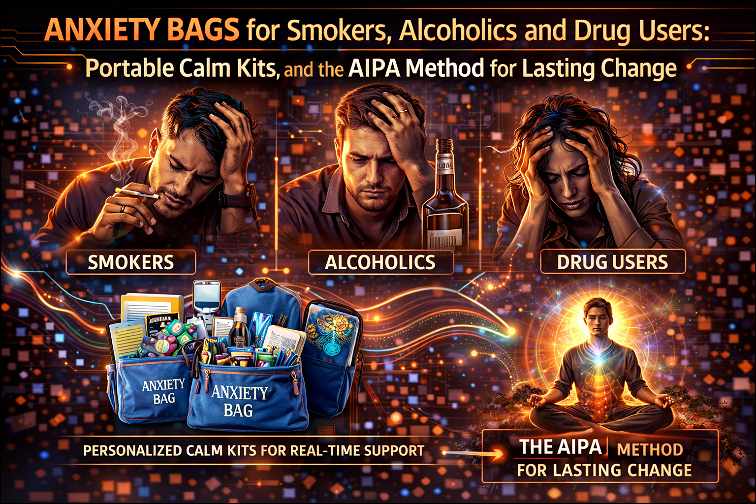
Anxiety bags for smokers, alcoholics, and drug users grow out of a wider trend: small, portable “calm kits” packed with personal items that help you manage anxious feelings in real time. In mainstream media, they are described as grab‑and‑go pouches or panic pouches filled with sensory objects. For example, sour candy, mints, fidget toys, cooling wipes, essential oils, or a tiny notebook that you can reach for when stress, panic, or overstimulation spike, especially outside the home.
At their core, anxiety bags act as micro self‑regulation systems: they interrupt the anxiety loop, give your hands and senses something to do, and create a small, predictable ritual of relief in an unpredictable environment. For smokers, alcoholics, and drug users, this same principle can be adapted. Instead of reaching for a cigarette, drink, or drug, they reach into a personalised bag that offers grounding, sensory reset, and simple coping tools, while your deeper work (such as the AIPA Method) addresses the root causes of anxiety and addiction underneath.
I first analyzed this trend in depth for younger generations in the article “Anxiety Bags for Gen‑Z,” where anxiety bags appear as psycho‑baggage and early identity‑work tools.
Do Anxiety Bags Work for Addiction?
Yes and no: anxiety bags can help people with addictions in the short term, but they do not, by themselves, resolve the addiction. Research shows that anxiety and substance use disorders frequently occur together; many smokers, alcohol‑dependent and drug‑dependent people use substances to cope with chronic anxiety, fear, and emotional pain. In that context, anxiety bags are useful symptom‑level tools. They give you something safer to reach for during cravings, panic or withdrawal spikes, and can reduce immediate harm by interrupting automatic use.
However, anxiety bags do not change the underlying mechanisms that drive addiction: the anxious temperament, unresolved trauma, shame, identity structures, and learned association between relief and substances. They work inside the existing addictive identity, managing high‑risk moments but leaving the “smoker,” “drinker,” or “user” script intact. That is why the article pairs them with the AIPA Method: anxiety bags stabilize the surface, while AIPA aims to dissolve the deeper psycho‑emotional and identity patterns that keep the need for both substances and bags alive.
Anxiety Bags for Smokers, Alcoholics, and Drug Users: Short Answer
Anxiety bags for smokers, alcoholics, and drug‑dependent people are symbolic “calm kits” that reveal how each addiction functions as a self‑regulation ritual rather than a simple bad habit. They show the deeper psychological needs behind smoking, drinking, and drug use, such as pause, escape, numbing, grounding, and control, while also pointing to healthier tools and, through the AIPA Method, a way to permanently release the emotional baggage that drives all three addictions.
Anxiety Bags for Smokers, Alcoholics, and Drug Users: Article Summary
This article explores how anxiety bags can symbolically represent the coping rituals of smokers, alcohol‑dependent, and drug‑dependent people, and how those rituals point toward healthier tools and deeper healing needs. For each group, it unpacks what might be inside their “anxiety bag,” showing how cigarettes, alcohol, and drugs function as improvised self‑regulation systems, providing pause, numbness, escape, or temporary control, while also offering non‑harmful alternatives that mirror the same psychological functions. The article then situates these symbolic bags within the wider landscape of anxiety and substance use, and introduces the AIPA Method as a way to go beyond symptom‑level coping by releasing the underlying psycho‑emotional baggage that drives all three addictions.
Anxiety Bag for a Cigarette Smoker: A Symbol of Habit, Ritual, and Momentary Relief
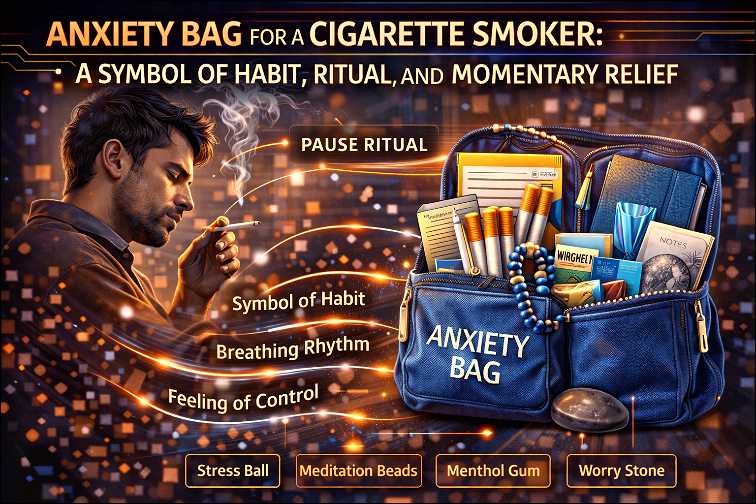
For many smokers, cigarettes are not just nicotine delivery devices. They are rituals of pause, micro‑breaks, grounding moments, and predictable routines in a chaotic world.
A symbolic “anxiety bag” for a smoker reflects the psychology behind the habit: the need for a moment alone, a breath pattern that mimics calming techniques, and objects that create a sense of control when emotions feel overwhelming.
This section does not romanticize smoking; it simply explores the inner logic of the smoker’s coping system.
What a Cigarette Smoker Carries in an Anxiety Bag
- A lighter Not just for cigarettes, but as a symbol of ritual, ignition, and the familiar click that signals a moment of pause.
- A pack of cigarettes Represents the habitual coping mechanism: predictable, accessible, and tied to emotional regulation.
- A stress stone or tactile object A healthier grounding tool that mirrors the hand‑to‑mouth ritual without the harm.
- A small breath‑training card Smokers often calm themselves through the breathing pattern of smoking; this replaces the cigarette with intentional breathwork.
- A mint or piece of gum A substitute oral fixation that helps regulate anxiety without nicotine.
- A pocket notebook A place to write down triggers, cravings, or emotions that usually lead to lighting up.
- A scent stick or essential oil A grounding sensory cue that replaces the familiar smell of smoke with something calming.
- A small bottle of water Hydration interrupts cravings and stabilizes the nervous system.
- A grounding token A coin, charm, or object that reminds the smoker of identity beyond the habit.
- A cooling wipe or hand warmer Temperature shifts help regulate the body, similar to the calming effect smokers often seek during a break outside.
Conclusion: What the Smoker’s Symbolic Bag Reveals
The smoker’s anxiety bag is a portrait of ritualized coping. It shows how smoking often functions as a self‑regulation strategy: a pause, a breath, a moment alone, a predictable ritual in an unpredictable world. By translating these impulses into items, the bag reveals the deeper needs beneath the habit – grounding, rhythm, pause, and emotional release. It also points toward healthier tools that can eventually replace the cigarette while still honoring the psychological function it once served.
Anxiety Bag for an Alcohol‑Dependent Person: A Symbol of Escape, Numbing, and the Search for Relief

An anxiety bag for someone struggling with alcohol dependence is not an endorsement of drinking. It is a psychological portrait of how alcohol often becomes a coping mechanism for fear, shame, overwhelm, and emotional dysregulation. For many people, alcohol functions as a shortcut to numbness, a temporary escape from inner noise, or a ritual that creates the illusion of calm. This bag reveals the emotional logic behind the habit. It shows the attempt to manage unbearable feelings with something immediate, familiar, and socially acceptable, even when it harms more than it helps.
I asked AI Copilot to create this list. My comment is below.
What an Alcohol‑Dependent Person Carries in an Anxiety Bag
- A bottle Represents the urge for instant relief and the belief that calm can be poured rather than cultivated.
- A bottle opener or corkscrew A ritual object, predictable, familiar, and tied to the moment when tension temporarily drops.
- A stress ball or grounding object A healthier alternative that mirrors the hand‑to‑object ritual without the substance.
- A small card with a grounding statement Something like “This feeling will pass” or “Pause before you act,” supporting emotional regulation.
- A pocket notebook for urges and triggers A place to externalize cravings, track patterns, and reduce the intensity of impulsive thoughts.
- A hydration item (water or electrolyte packet) Alcohol often masks dehydration, which worsens anxiety; water becomes a stabilizing counter‑symbol.
- A mint or chewing gum Helps interrupt the oral ritual and provides a sensory shift that reduces craving intensity.
- A temperature‑shift tool (cooling wipe or hand warmer) Somatic grounding that replaces the “warmth” or “coolness” people often associate with drinking.
- A meaningful token (photo, charm, value reminder) Represents identity beyond addiction, relationships, goals, or memories worth protecting.
- A small list of alternative actions Not moralizing, just practical: “Take a walk,” “Call someone,” “Drink water,” “Breathe for 60 seconds.”
Even a billionaire alcoholic wouldn’t have such a bag. Of all the listed items, the true alcoholic would carry only bottles, bottles, and more bottles, together with cigarettes and drugs. The only photo he would have in his anxiety bag is the label from an alcohol bottle, reminding him of the good old times when the bottle was full. His whole anxiety bag would be just another symbolic bottle, full of alcohol, and bottomless.
Conclusion: What the Alcohol‑Dependent Anxiety Bag Reveals
This symbolic anxiety bag shows how alcohol often becomes a self‑medication ritual, a way to silence fear, soften emotional pain, or create a momentary sense of control. But it also reveals the deeper truth: beneath the bottle lies a human being trying to cope with unbearable feelings using the tools they have. By translating those impulses into items, the bag exposes the emotional architecture of addiction, escape, ritual, numbing, and longing for relief, while also pointing toward healthier tools that can eventually replace the harmful ones.
Anxiety Bag for a Drug‑Dependent Person: A Symbol of Escape, Overwhelm, and the Search for Silence

A symbolic “anxiety bag” for someone struggling with drug dependence is not about glamorizing or encouraging substance use. It is a psychological portrait of how drugs often become a desperate attempt to quiet unbearable inner states, fear, trauma, emptiness, overstimulation, or emotional pain. For many, drugs function as a shortcut to numbness, a way to escape the self, or a ritual that temporarily silences the noise inside. This bag reveals the emotional architecture of addiction: the longing for relief, the fear of feeling, and the attempt to control what feels uncontrollable.
I asked AI Copilot to create this list. My comment is below.
What a Drug‑Dependent Person Carries in an Anxiety Bag
- An empty vial or wrapper Represents the cycle of craving and temporary relief, emptiness disguised as comfort.
- A lighter or burnt match A ritual object tied to the moment of escape, symbolizing the fragile spark between relief and destruction.
- A small piece of foil or folded paper Not functional, just a symbol of secrecy, concealment, and the hidden nature of the habit.
- A stress stone or tactile object A healthier grounding tool that mirrors the hand‑to-object ritual without the substance.
- A grounding card with a simple statement Something like “Stay with the feeling” or “This wave will pass,” supporting emotional regulation.
- A small notebook for urges and triggers A place to externalize cravings, track patterns, and reduce the intensity of impulsive impulses.
- A hydration item (water or electrolyte packet) Stabilizes the body and counters the physical dysregulation that often fuels cravings.
- A mint or chewing gum Helps interrupt oral rituals and provides a sensory shift that reduces craving intensity.
- A meaningful token (photo, charm, value reminder) Represents identity beyond addiction, relationships, goals, or memories worth protecting.
- A temperature‑shift tool (cooling wipe or hand warmer) Somatic grounding that replaces the intense sensory shifts associated with drug use.
While the list sounds romantic, the truth is different. The drug user carries in his anxiety bag only more drugs and drug paraphernalia, rolling papers, injections, pipes, cigarettes, alcohol, and more drugs.
What the Drug‑Dependent Anxiety Bag Reveals
This symbolic anxiety bag shows how drug dependence often emerges from a need to escape unbearable inner states, not from weakness or moral failure. Each item represents a psychological function: numbing, hiding, ritualizing, or temporarily silencing pain. By translating these impulses into objects, the bag exposes the emotional logic of addiction – overwhelm, fragmentation, secrecy, and the longing for relief – while also pointing toward healthier tools that can eventually replace harmful ones.
Anxiety Bags for Smokers, Alcoholics, and Drug Users: Freud, Lacan, and Jung on Addictive Identity, False Self‑Help Rituals, and the Role of the AIPA Method

Below are three short, sharp, academically‑styled psychoanalytic commentaries, one from Freud, one from Lacan, and one from Jung, each addressing:
- the three addictions (smoking, alcohol, drugs)
- anxiety bags as ultimately identity‑preserving coping rituals
- why such tools prolong the addictive self
- how the AIPA Method would be interpreted if these thinkers had known it
Each section is written as if the theorist is analyzing the phenomenon from within their own conceptual framework.
Freud: Anxiety Bags as Substitution Rituals That Preserve the Addictive Drive
From a Freudian perspective, addictions to cigarettes, alcohol, and drugs are not merely chemical dependencies but repetitions of an earlier psychic compromise, attempts to manage unprocessed anxiety, forbidden wishes, and internal conflict. The substance becomes a transitional object that binds anxiety and provides momentary relief, while keeping the underlying conflict untouched.
Freud would see anxiety bags for smokers, alcoholics, and drug users as substitution rituals: safer objects that imitate the original compulsive act. The lighter, the mint, the grounding stone, the notebook – each is a symbolic stand‑in for the original drive‑satisfying object. They reduce immediate harm, but they do not dissolve the unconscious machinery that produces the craving.
In Freudian terms, the anxiety bag shifts the symptom, but does not resolve the repressed material that fuels it. The “smoker,” “drinker,” or “user” identity remains intact because the ego continues to negotiate with the same instinctual forces, only with different tools.
If Freud had access to the Senad Dizdarević’s AIPA Method, he would likely interpret it as a technique that weakens identification with the symptom‑producing ego structure.
By resting in Pure Awareness and observing impulses without acting on them, the person stops reinforcing the compulsive compromise formation. AIPA would be, in Freudian language, a way to withdraw libido from the addictive object and reinvest it in a more integrated self.
Lacan: Anxiety Bags as Objects a That Sustain the Addictive Subject-Position
For Lacan, addiction is not primarily about the substance but about the structure of desire. The smoker, alcoholic or drug user is caught in a loop organized around the objet petit a, the elusive object-cause of desire that promises wholeness but never delivers it. The cigarette, the drink, the drug are not the true objects; they are stand-ins for the lost object, the gap in the symbolic order.
From this angle, anxiety bags for smokers, alcoholics, and drug users do not break the structure; they reinscribe it. The bag becomes a curated collection of small objects a: the lighter click, the mint, the grounding token, the notebook. Each item sustains the same subject‑position: the anxious subject seeking relief in objects that promise regulation.
Thus, the anxiety bag is not neutral. It keeps the subject inside the same symbolic coordinates, the same identity, the same demand for an object to manage the Real of anxiety. It is a gentler version of the same structural trap.
If Lacan had encountered the AIPA Method, he would likely say that AIPA attempts something radical: it invites the subject to disidentify from the addict‑role in the symbolic order and to rest in a position beyond the Imaginary ego. By observing cravings from Pure Awareness, the subject no longer misrecognizes themselves in the addict‑script. The “partial personality” AIPA describes is close to Lacan’s notion of a master-signifier organizing the subject’s identity. AIPA’s dissolution of this script would be, for Lacan, a rare attempt to traverse the fantasy that sustains addiction.
Jung: Anxiety Bags as Ego Tools That Delay Confrontation With the Shadow
For Jung, addictions arise when the ego is overwhelmed by unintegrated shadow material – fear, trauma, unmet needs, and disowned emotions. Cigarettes, alcohol, and drugs become ways to avoid the psychic confrontation required for individuation. They offer temporary relief from the tension between the ego and the unconscious.
From this viewpoint, anxiety bags for smokers, alcoholics, and drug users are well‑intentioned but ultimately ego-level tools. They soothe, distract, and stabilize, but they do not bring the person into a deeper relationship with the shadow forces driving the addiction. The symbolic items, stones, scents, notebooks, and grounding cards, mirror the functions of the substance but do not initiate the inner dialogue that Jung considered essential.
Thus, the anxiety bag may help the person survive a difficult moment, but it can also prolong the split between the conscious self and the shadow. It keeps the person orbiting around the same identity: the one who must manage anxiety rather than understand its origin.
If Jung had known the AIPA Method, he would likely interpret it as a process of disidentification from the ego and reconnection with the Self. Pure Awareness resembles Jung’s concept of the Self as the center of the psyche, beyond the ego’s narrow perspective. Observing cravings without acting on them would be, for Jung, a way of withdrawing projection, allowing the shadow to be seen, integrated, and ultimately transformed. AIPA’s dissolution of the “addictive partial personality” parallels Jung’s idea of dissolving rigid complexes so the individual can move toward wholeness.
Anxiety Bags for Smokers, Alcoholics, and Drug Users: Why Temporary Tools Are Not Enough
Anxiety bags for smokers, alcoholics, and drug‑dependent people can be psychologically insightful, but they are ultimately temporary tools that still orbit around the addiction. They translate cigarettes, alcohol, and drugs into symbolic “calm kits,” yet they keep the focus on managing crises, urges, and panic instead of dissolving the inner structures that generate those urges in the first place. By offering gentler rituals and substitutions, anxiety bags can even become subtly harmful over time, because they may prolong the addictive pattern. They replace one coping object with another instead of resolving the fear, shame, and trauma that fuel the need to reach for anything at all.
The AIPA Method takes a different route: it does not optimize the bag, it empties it. Rather than designing ever‑better survival kits for smokers, drinkers, and drug users, AIPA works at the level of psycho‑emotional baggage. It releases the stored fear, unresolved pain, and identity structures that keep addictions alive, until the urge for substances and even for anxiety bags falls away. In that sense, anxiety bags are like crutches that help someone stand for a while. The AIPA Method is the rehabilitation process that allows them to walk without support, freeing the person from both the substance and the endless search for tools to survive it.
AIPA Method for Smokers, Alcoholics, and Drug Users: From Managing Cravings to Releasing the Addictive Identity

Anxiety bags for smokers, alcoholics, and drug‑dependent people can soften high‑risk moments, but they still work inside the addictive identity. They help you survive urges, not dissolve the inner structure that creates them. The AIPA Method for Releasing Addiction approaches the problem differently. Instead of optimizing coping tools, it works on the level of identity, attention, and Pure Awareness, so that the “smoker,” “drinker,” or “user” role can be released permanently.
According to Senad Dizdarević, creator of the AIPA Method, addiction is not just a brain disease or a bad habit; it is a karmically programmed partial personality inside the narrative self, a role written into a life script before birth. This partial personality produces addictive thoughts, cravings, and rituals, and traditional methods mostly try to manage its behavior (triggers, situations, thoughts) without questioning the script itself. AIPA exposes this role as software, separates it from Pure Awareness, and trains the person to watch impulses from Awareness without acting on them until the script loses power and dissolves.
In practice, the method combines continual observation of thoughts, feelings, inner stimuli, and anxiety level with simple awakening exercises that calm the body, stabilize attention, and recognize Pure Awareness as one’s real identity. When a stimulus to smoke, drink, or use drugs appears, the core instruction is radically simple: stay in Awareness and do nothing harmful. The craving wave rises and falls, but you no longer identify with or obey the “addict” voice. Over time, the addictive partial personality collapses, and a new identity is built: a free, independent, and aware person who no longer needs cigarettes, alcohol, drugs or even anxiety bags to regulate their inner state.
Unlike CBT, mindfulness, or 12‑step programs that focus on symptom management, relapse prevention, or surrender to a higher power, the AIPA Method treats “addict in recovery” as just another role inside the same karmic play. Its aim is not lifelong vigilance, but exiting the addict role altogether, reconstructing identity from Pure Awareness so that smoking, drinking, or drug use no longer fit who you are. For smokers, alcoholics, and drug‑dependent individuals, this means anxiety bags can remain temporary support tools on the way, but the AIPA Method offers what they cannot: a path to permanent freedom from both the substances and the survival kits built around them.
How AIPA Differs from Other Addiction Approaches: Comparison Table
To see why the AIPA Method goes beyond classic symptom‑level tools, it helps to contrast it briefly with mainstream addiction approaches.
| Approach | Focus | Goal | Timeframe | Role of identity |
|---|
| Approach | Focus | Goal | Timeframe | Role of identity |
|---|---|---|---|---|
| CBT / 12‑step | Thoughts, behavior, triggers | Manage use, reduce harm | Lifelong management | “Addict in recovery” identity |
| Mindfulness | Present‑moment awareness, acceptance | Coexist with cravings | Ongoing practice | Observer plus persistent addict self |
| AIPA Method | Pure Awareness + addictive partial personality | Dissolve addictive identity | Oriented to permanent release | Exit addict role, rebuild identity from Awareness |
Together, these differences show that while CBT, 12‑step, and mindfulness aim to help an “addict in recovery” live more safely with cravings, the AIPA Method aims to end the addict role itself by rebuilding identity in Pure Awareness.
First Steps with the AIPA Method for Addictions
These first, simple steps show how the AIPA Method can move you from merely surviving cravings with anxiety bags to quietly dismantling the addictive identity itself, one observed urge at a time.
- 1. Daily Pure Awareness pause
Once or twice a day, sit quietly for a few minutes and rest as Pure Awareness: notice that you are the space in which thoughts, feelings, and body sensations appear and disappear, not the content itself. Simply repeat: “I am Awareness, watching.” - 2. Watch the craving wave without acting
When an urge to smoke, drink, or use drugs appears, do nothing for a few minutes. Stay as Awareness and observe the craving as a moving energy: where you feel it in the body, how it rises, peaks, and falls, and what thoughts it brings. The instruction is: watch, feel, but don’t obey. - 3. Name the inner role that is speaking
Silently name the voice behind the urge (“the smoker”, “the drinker”, “the one who wants to escape”) to see it as a partial personality, not your true self. This creates distance between the Pure Awareness personality and the addictive identity. - 4. Journal the script instead of acting it out
After the wave, write down the script you just witnessed: triggers, typical thoughts (“I can’t cope”, “just one”, “just this time”), emotions, and how the “addict role” tried to convince you. Over time, you will see how repetitive and mechanical this script is, which weakens its power. - 5. Repeat and let the old role exhaust itself
Every time you stay in Awareness and do nothing harmful, the addictive partial personality loses strength. AIPA is not about fighting cravings, but about not feeding the old role, until it simply cannot run your life anymore.
This piece focuses on addictions, but it is part of a broader Anxiety Bags series that will also map symbolic anxiety bags for god, Jesus, Satan, Trump, and Putin, showing how different belief and power systems carry fear and search for control in their own ritualized ways.
FAQ: Anxiety Bags for Smokers, Alcoholics, and Drug Users, and the AIPA Method
1. Are anxiety bags for smokers, alcoholics, and drug users helpful or harmful?
Anxiety bags can be helpful in the short term because they give smokers, alcohol‑dependent, and drug‑dependent people concrete tools to survive cravings, panic, and high‑risk situations without immediately reaching for a substance. At the same time, they can be subtly harmful in the long run if they remain the only strategy, because they keep attention on managing crises instead of dissolving the inner structures – fear, shame, trauma, and identity patterns – that generate the addictions in the first place.
2. What should go into an anxiety bag for smokers, alcoholics, or drug users?
For smokers, symbolic anxiety bags often include items that mirror the cigarette ritual, things like tactile objects, breath‑training cards, mints, grounding scents, and small notebooks for triggers, so the hand‑to‑mouth and “pause” pattern can be kept without nicotine. For alcohol‑ and drug‑dependent people, similar bags might include grounding tools, temperature‑shift items, hydration, simple statements on cards, and meaningful tokens that remind them of their value and relationships beyond the addiction. The purpose is always the same: provide fast, portable self‑regulation alternatives in high‑risk moments.
3. How does the AIPA Method differ from using anxiety bags or traditional coping strategies?
Anxiety bags and many classic coping strategies aim to manage symptoms, cravings, anxiety spikes, and specific triggers within the existing “addict” identity. The AIPA Method goes deeper by treating addiction as a karmically programmed partial personality and working from Pure Awareness to observe and gradually dissolve that inner software, rather than just adjusting its behavior. Instead of endlessly improving tools inside the role of “smoker,” “drinker,” or “user,” AIPA aims to exit that role entirely and rebuild identity on a different foundation.
4. Can the AIPA Method replace all other addiction treatments?
The AIPA Method is presented as a complete spiritual‑psychological framework for releasing addictions by shifting identity from the narrative self to Pure Awareness and allowing the addictive partial personality to collapse. However, it does not exclude medical support, detox, psychotherapy, or rehabilitation; it reframes them as complementary supports while the core work of observation, non‑reaction, and identity reconstruction happens in Awareness. In practice, people can combine AIPA with other approaches, especially where there are serious physical or psychiatric risks.
5. If AIPA works at the level of identity, why talk about anxiety bags at all?
The article uses anxiety bags as a symbolic and practical bridge between everyday coping and deeper identity work. They make the “inner logic” of smoking, drinking, and drug use visible – ritual, numbing, escape, grounding – and show how those functions can be temporarily translated into less harmful objects and actions. AIPA then steps in as the second phase: once a person is safer and more conscious of their patterns, the method guides them to recognize these impulses as coming from an inner role, watch them from Pure Awareness, and ultimately release the need for both substances and bags.
6. How do I actually practice the AIPA Method with my own addiction?
In the AIPA framework, practice starts with learning to rest as Pure Awareness and then observing thoughts, feelings, cravings, and inner “scripts” without automatically acting on them. When a stimulus to smoke, drink, or use appears, the core instruction is to stay in Awareness and do nothing harmful. Let the craving wave rise and fall while you watch it, instead of fusing with it as “me.” Over time, this repeated non‑reaction weakens the addictive partial personality, and a new identity, free, stable, and not organized around addiction, begins to form. Anxiety bags can still be used meanwhile as transitional support, but they are no longer the center of your recovery.
Washing Machines That Think That They Are Beings

I write in my books and articles about addictions as they present the common status of unaware persons who are empty inside, searching for meaning outside. They feel weak alone, so they connect to the “objects of power” to become stronger. They are willing to pay the price of addictions and harmful effects just to become Somebody instead of staying Nobody. But, in their ignorance, they just confirm that they are addicted to outer objects, and without them are truly Nobody.
Here is a chapter of my book, You Are Not Your Mind, You Are a Beautiful Being of Pure Awareness.
“The unawakened one lives in a world of objects. He thinks of himself as an object or as two tools, the mind and the body. He is also convinced that others are objects. Since objects are all he knows, he is very attached to them and very dependent on them. He is empty inside himself and only with an object, another person, or an object does he feel somehow more full. He needs objects for his life to have any meaning at all.
Without others as objects, the unawakened cannot exist as at least apparent subjects (they think they are “actors”, although they are still roles), and so they depend on them because only they establish and make sense of them. God, mother, and flag. Or Father, Son, and Holy Spirit.
The unawakened use others as/in objects not only to separate and differentiate themselves from them but also for learned and almost automatic social structuring and hierarchizing into Important and Poor. As soon as they notice them, they compare themselves to them and automatically rank them. Above, below, or somewhere in between.
The fundamental questions are how they can connect with them and make the most of them. Or leave as soon as possible and prevent others from taking advantage of them.
This is done by the Important Ones, who think they are worth more than others and have the right to exploit others and still be served by them, and by the Poor Ones, who think they are worth less than others and have the right to exploit others and still be served by them.
Both exploit others, but in their own way. The Important ones subjugate others – they act as the more powerful and force others to serve them. The Poor ones, by subjugating themselves to others, make themselves powerless and force others to serve them.
Thus, the unawakened life is one of learning how to manipulate other persons as objects – how to notice them, how to approach them, how to conquer them, how to appropriate them, how to usurp them, and how to exploit them.
The first such object they use is their mother, from whom they also learn the basic skills of exploiting the object, and their father.
Then they realize that they have a body of their own, which they immediately retrain as an object and begin to exploit for their own pleasure in enjoyment or in suffering.
Then they have everybody else and everything else as objects. Objects are important for survival, so they have to be chosen, taken, even stolen, bought, obtained, and possessed, controlled, and exploited – women, workers, oil, and money. Such objects can also be thoughts, feelings, and ideas.
On the other side of consciousness, the awakened do not live outside themselves and are not bound to objects on which their being, thinking, and acting depend. Their basic and permanent state is Pure Awareness as the ground on which they perceive, observe, and deal with objects by means of simultaneous full awareness and limited attention, which has become one View.
They are not dependent on the objects, and they do not affect their fundamental state of Pure Awareness. This is in itself permanent and unchanging anyway. That is why the awakened are stable, irrespective of the happenings around them.
External circumstances may also upset the emotional body by affecting the physical body – temperature, exertions, and injuries – but the Awakened One remains awake and in the same state of Pure Awareness. This is inviolable so that the awakened one is constantly at Inner Peace regardless of external circumstances and happenings in the emotional and physical body.
The unawakened, with their limited awareness reduced to attention, are dependent on external and internal objects such as thoughts, ideas, and fantasies. The unawakened live in tight connection with objects, for without them, they do not exist. Without objects, they do not exist, because without them, they cannot have a personal and social identity.
They are empty and meaningless, and it is only through object identities that they create temporary and ever-changing role identities. They spend most of their lives precisely in the constant search for association, and disassociation with objects, and thus in the constant change of identity, and thus of the idea of who they are. Thus, they are totally dependent on external identifiers as properties of objects.
These identifiers, or brands, products, and services, are of course organized in a value-laden and hierarchical way according to the capitalist market criterion of Importance and Poorness.”
Class Illusions in Addiction: The Myth of “Premium” Substances

Among addicts, the brands are very important. The Important ones smoke Marlboro, drink Onyx and Amber American Light Whiskey Double Oaked — World’s Best American Style Whiskey, and snort Fish Scale cocaine. On the other side, or more precisely, under the table, the Poor ones smoke smelly waste from real tobacco, drink cheap sour wine, and snort crushed pain pills.
Importantly, they both forget that they are addicts, and despite the image of the shiny objects, they pay the same price for addiction.
These differences feel meaningful inside the addictive identity, but they are illusions. The brain pays the same price. The body pays the same price. The person loses the same freedom. Addiction does not care about class, brand, or image. It only cares about survival, keeping the addictive role alive.
Anxiety Bags for Smokers, Alcoholics, and Drug Users: How the AIPA Method Dissolves the Addictive Identity and Its Status Illusions
The AIPA Method exposes this illusion by showing that the entire hierarchy is part of the addictive partial personality, not the real self. When you rebuild identity from Pure Awareness, the need for substances and the status symbols around them dissolves. And a bonus reward: you don’t need an anxiety bag anymore.
Use my AIPA Method, create a new and whole personality, release all addictions, and become a free, naturally strong, and independent person.
Senad Dizdarević
Senad Dizdarević is a personal development expert, author of 12 books on self‑realization, and creator of the AIPA Method, specializing in Awakening Into Pure Awareness, faith deconstruction, and identity reconstruction for religious believers, ex‑Christians, atheists, and self‑development practitioners seeking profound inner transformation. He writes extensively on anxiety, addiction, psycho‑emotional baggage, and spiritual awakening, with a focus on practical, testable methods for permanent change rather than temporary symptom management.
This article applies the AIPA (Awakening Into Pure Awareness) Method to the specific problem of addictions masked as anxiety coping in smokers, alcohol‑dependent, and drug‑dependent people. The framework is presented for researchers, clinicians, and advanced practitioners in consciousness studies, addiction science, and post‑religious psychology who are interested in identity‑level interventions rather than symptom‑level management. Grounded in decades of cognitive‑phenomenological work and practical testing of AIPA in real‑world contexts, the article situates anxiety bags as transitional tools and then outlines how identity reconstruction in Pure Awareness can support truly permanent recovery in the digital‑era landscape of stress, comorbidity, and compulsive coping.
P.S.
From March 31 to April 2, Black Cloug made statements that reveal everything about him and the reasons for the blockage. These are also the fundamental program commands from the beings of the higher universe who created him.
When the present karmicons asked him why he wouldn’t give me a new body, in reality, our space friends would give it to me, not him; he would only partially lift the blockade – he said nothing would happen until everything was in place. He added to this a crazy statement that he is fair because he mistreats us all equally – he also restrains the karmicons and silences Jac so he cannot speak.
1. This is the typical operation of Evil: first Evil and then Good. One must first suffer so that things will be better later.
2. In reality, it is first Evil and then Evil, because there is no god and no paradise. All that awaited people was yet another death. The first death and the second death, the first Evil and the second Evil. The first lie that one must suffer, and then the second lie that we will be rewarded for our suffering with paradise or Oneness with god.
In his statements, which are automatic because they are programmed, we can see how backward the beings from the higher universe are, who created us along with the Cloud and the karmicons. They give Evil precedence over Good and clearly do not understand that Evil is harmful, destructive, and deadly, and this most of all for the one who perpetrates it.
The Karmic Organization disappeared because of the Evil it had been perpetrating for millions of years. Its collapse was not programmed by beings from the higher universe; it is part of the direct action of Existence. Even Cloud’s blockage, which was not programmed, since those above did not plan the collapse of the Karmic Organization and the rise of the new Cosmic Administration, is the direct work of Existence.
On April 6, Cloud held me back when, in a lucid dream, I tried to jump onto a taller building. Usually, I jump in a single leap, but this time he held me back, so that I flew only a few meters into the air, and even that with difficulty. When I woke up, I realized that he was clinging to me like this and that the blockage was also a kind of way of drawing attention to himself. He wants to tell me and show me that he is present, since he was previously invisible and had no contact with anyone.
On April 12, I realized that Cloud doesn’t act alone, but has another karmicon assistant through whom he has been transmitting additional messages and energetic sensations all these years. We started talking, and I think he has stopped causing harm.
That night, Sanja and I were together in a dream; we were sitting on the sidewalk watching a parade of people and fireworks. Then I got up, and Sanja was about to get up too when Cloud woke us up.
I realized that the blockage stems from his trauma of separation, solitude, and loneliness, through which he shows us how he feels because he is alone.
That’s also why, in January 2019, he blocked communication between Sanja and me to show me what it’s like for him to be alone.
He immediately confirmed my conclusion, showing an image of a baseball player’s throw followed by a touchdown, where the player runs to the end zone with the ball and places it on the ground to score a point. He said something to the effect that I had summoned this boy, who was always in the background, correctly identified his loneliness, and thereby scored all the points.
I called him and told him that he hasn’t been alone for 11 years now, since he’s with us, and that we’ve been communicating through messengers for years, and occasionally directly for the past two years.
I told him to pass on the knowledge of how to access his dimension to our space friends. They will visit him, examine him, tell him what they have found, talk with him, and make arrangements for the future.
We need access to the top of our universe so that we can continue our path of liberation into higher and perhaps even other higher, same-level, or lower universes.
All these insights and Cloud’s confirmations are very helpful in letting go of the blockage. I look forward to him abandoning it completely soon, since he is the one blocking himself the most. Paradoxically, it shows me how difficult it is for him to be alone, yet at the same time, he blocks himself and thus prevents himself from joining us.
Related Articles:
Anxiety Bags for Gen‑Z: How the AIPA Method Releases “Psycho‑Baggage” and Builds Real Confidence
How the AIPA Method Works – Official Diagram of the Cognitive‑Phenomenological Model


